



Skip to content

CFD Là Gì? Computational Fluid Dynamics

CFD là gì?

CFD Là Gì?

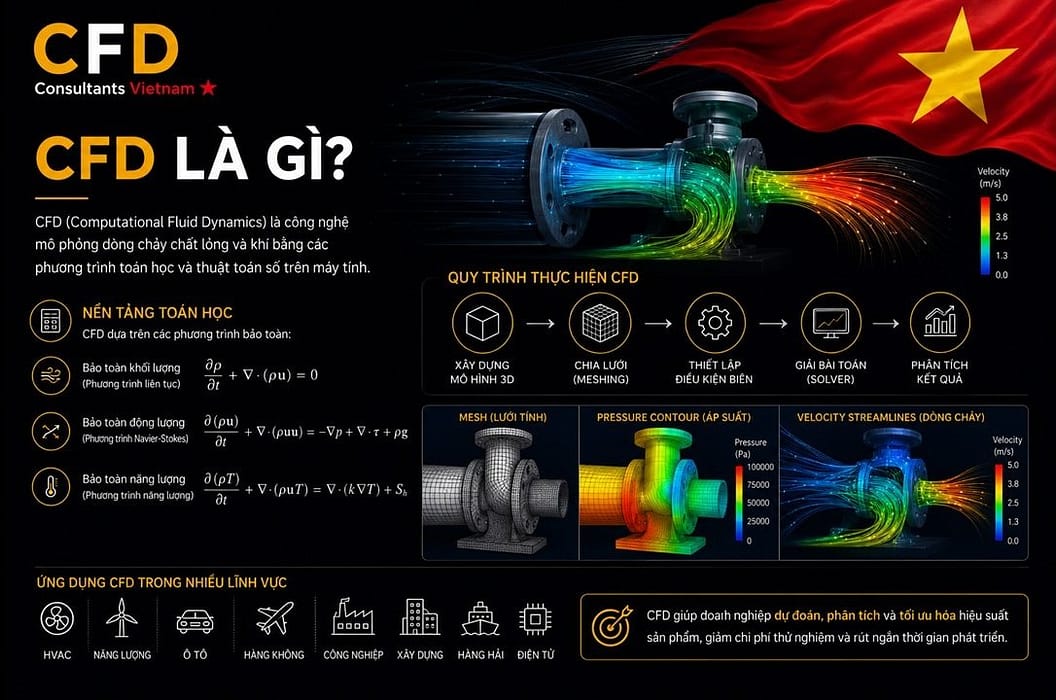
CFD (Computational Fluid Dynamics) hay Động lực học chất lưu tính toán là một phương pháp mô phỏng bằng máy tính được sử dụng để phân tích và dự đoán cách chất khí và chất lỏng chuyển động trong thực tế. Thông qua CFD, các kỹ sư có thể quan sát và đánh giá những hiện tượng như luồng không khí, dòng nước, sự lan truyền của khói, sự phân bố nhiệt độ hay áp suất bên trong một hệ thống mà không cần phải xây dựng mô hình thực tế.

Nói một cách đơn giản, CFD giúp biến những hiện tượng vô hình trở nên có thể nhìn thấy được. Ví dụ, khi thiết kế một tòa nhà, kỹ sư có thể sử dụng CFD để kiểm tra xem không khí có được phân phối đều hay không. Trong một nhà máy sản xuất, CFD có thể giúp xác định những khu vực tích tụ nhiệt hoặc có khả năng thông gió kém. Đối với các công trình yêu cầu an toàn cháy nổ, CFD được sử dụng để mô phỏng sự lan truyền của khói và đánh giá hiệu quả của hệ thống hút khói.

CFD hoạt động dựa trên việc giải các phương trình toán học mô tả sự chuyển động của chất lưu và sự truyền nhiệt. Trước tiên, kỹ sư xây dựng mô hình 3D của công trình hoặc thiết bị cần phân tích. Sau đó, phần mềm CFD chia mô hình này thành hàng nghìn hoặc hàng triệu phần tử nhỏ để thực hiện các phép tính. Kết quả cuối cùng được thể hiện dưới dạng hình ảnh trực quan, cho phép người dùng quan sát vận tốc dòng chảy, nhiệt độ, áp suất hoặc hướng chuyển động của không khí và chất lỏng.

Ngày nay, CFD được ứng dụng rộng rãi trong nhiều lĩnh vực kỹ thuật như hệ thống HVAC, thông gió tầng hầm, mô phỏng khói cháy, phân tích nhiệt cho nhà máy, tối ưu hóa đường ống, thiết kế thiết bị công nghiệp và nhiều bài toán liên quan đến dòng chảy chất lưu. Nhờ khả năng dự đoán hiệu suất ngay từ giai đoạn thiết kế, CFD giúp giảm rủi ro kỹ thuật, hạn chế các thay đổi tốn kém sau khi thi công và nâng cao hiệu quả vận hành của hệ thống.

Trong bối cảnh ngành xây dựng và công nghiệp ngày càng phát triển, CFD đã trở thành một công cụ quan trọng giúp các kỹ sư đưa ra quyết định thiết kế chính xác hơn. Thay vì chỉ dựa vào kinh nghiệm hoặc thử nghiệm thực tế, CFD cung cấp cơ sở khoa học để đánh giá và tối ưu hóa hiệu suất của công trình trước khi được xây dựng hoặc đưa vào vận hành.

Kết Luận

CFD (Computational Fluid Dynamics) là công nghệ mô phỏng giúp dự đoán và phân tích sự chuyển động của không khí, chất lỏng, nhiệt độ và khói trong các hệ thống kỹ thuật. Nhờ khả năng mô phỏng các điều kiện vận hành thực tế trên môi trường máy tính, CFD đang trở thành một trong những công cụ quan trọng nhất trong lĩnh vực xây dựng, HVAC, an toàn cháy nổ và công nghiệp hiện đại.

CFD Companies in India

Discover the expertise and services offered by CFD Consultants India, a trusted provider of Computational Fluid Dynamics (CFD) solutions in India.

CFD for Cement industry

Explore our  journey in the cement industry, where we harnessed CFD simulations to overcome challenges and revolutionize production processes.

Applications of CFD

Discover the wide-ranging applications of Computational Fluid Dynamics (CFD) across industries such as aerospace, automotive, energy……….

FAQ

Most frequent questions and answers

CFD (Computational Fluid Dynamics) is a branch of continuum mechanics which deals with fluid flows and associated phenomena like momentum, heat, and mass transfer within them.

CFD offers the ability to visualize flows that are otherwise invisible to the naked eye. Particularly in industrial processes where flow occurs within non-transparent metallic ducts and vessels, CFD becomes indispensable for gaining insights into flow behavior and identifying associated challenges.

  1. Defining the flow problem or stating the problem
  2. Preparing and cleaning the geometry (pre-processing)
  3. Creating a mesh for the flow domain (pre-processing)
  4. Defining appropriate boundary conditions (pre-processing)
  5. Executing the simulation until convergence (processing)
  6. Analyzing and interpreting the results after simulation (post-processing)

Meshing involves partitioning the flow volume into smaller control volumes. It’s important to note that finer meshes require more computation time, but they yield higher-quality CFD results.

FEA stands for ‘Finite Element Analysis,’ which involves mechanical analysis related to the behavior of materials under applied forces.

No, CFD (Computational Fluid Dynamics) and FEA (Finite Element Analysis) are not the same. CFD focuses on simulating fluid flows and related phenomena, while FEA is used to analyze the behavior of materials and structures under various mechanical loads.

CFD (Computational Fluid Dynamics) uses the Finite Volume Method (FVM), while FEA (Finite Element Analysis) employs mathematical techniques to solve equations for analyzing structures and materials.

Let's stay in touch!

To get recent updates, stay connect us on our LinkedIn page! Don’t hesitate to reach out to us for any questions, concerns or future collaborations

Contact Us

We are here to help! With just a quick input details we will be able to respond to your inquiry.

E-Mail: info(at)cfdconsultantsvietnam.com

CFD Consultants India a leading provider of CFD simulation consultation and services. We use finite volume computation technique to predict the flow behavior using various commercial CFD software’s.  At CFD Consultants India, we understand the importance of accurate and reliable CFD simulations in the design and development process. With years of experience and expertise in the field, we offer customized solutions to meet your specific requirements and help you achieve your goals.

Whether you are looking to optimize your product design, improve performance, reduce costs, or enhance safety, CFD Consultants India can help. Contact us today to learn more about our services and how we can help you achieve your goals.

© Copyright CFD Consultants India 2023 | All rights reserved.